Scenarios for Future Simulation

To understand exactly how our users will interact with and be affected by our app, we will need to simulate some different scenarios based on what we consider our target audience. But who exactly is our target audience?

As we’ve stated in earlier blog posts, our app is targeted towards families with children. Of course the app may also be used by other groups such as students in a dorm, couples living together or individuals, but we will ignore those and focus our research on families. This will make our app easier to develop since we narrow down the target audience.

In our simulations we plan to use two very different examples of families as scenarios. To fit our target audience, both will be families with children, but with differences in the family’s size, ages and general household which may greatly affect how they end up using the Family Manager.

  • Family 1
    • Members
      • Two adults
        • Male (40)
        • Female (35)
      • Three children
        • Female (8)
        • Male (10)
        • Female (12)
    • Household
      • Big house, a lot of maintenance required
      • Have both dishwasher and dryer
  • Family 2
    • Members
      • One adult
        • Female (38)
      • One child
        • Male (16)
    • Household
      • Small apartment
      • No dishwasher or dryer

To make sure these were realistic users, we needed to know if children this age would have access to a cellphone. After some research into media usage by children, we found that 90-100% of children of both genders own a cellphone at the age of 10 and above, and at the age of 8-9 about 50-90% own one. This can be seen in the graph below from Medietilsynet (The Norwegian Media Authority), which shows parents reporting on whether or not their children own a cellphone.

Our next step will be to do some further research into the specific expected phone usage, activities and behavior of each individual in our scenarios, then we can start simulating!
A Look into Motivation

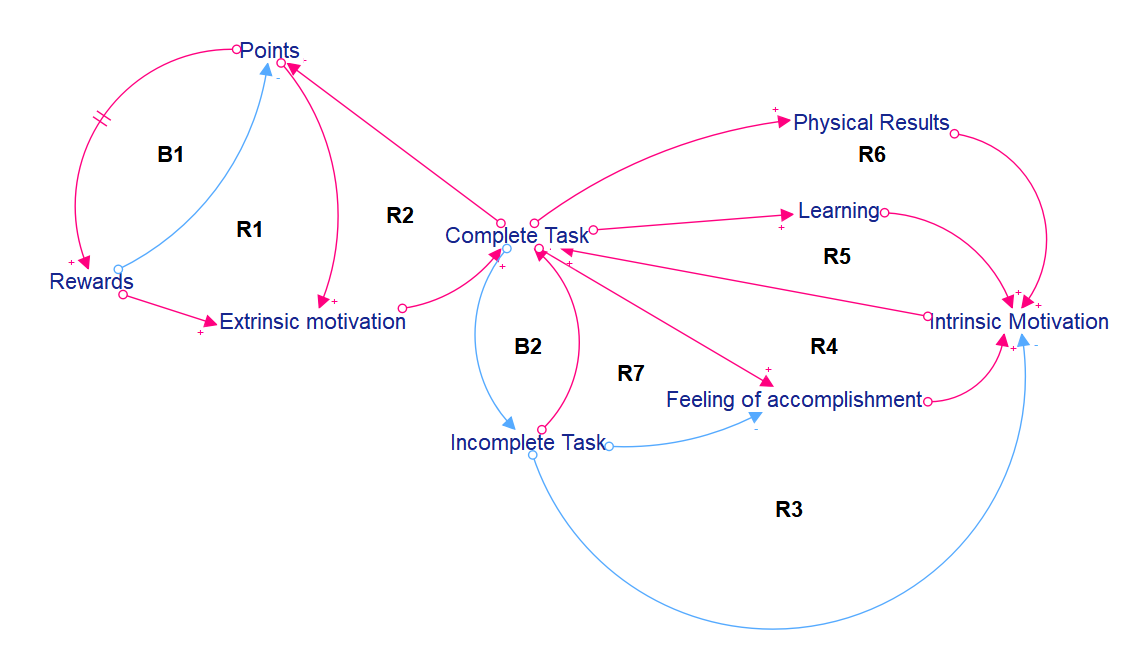
To make sure our app can give the user both intrinsic and extrinsic motivation, we took a closer look into motivation by creating a CLD.

This CLD shows how our application affects the users’ extrinsic and intrinsic motivation. As shown, there are a lot of loops affecting the intrinsic motivation.

Intrinsic motivation
When you complete a task, you get physical results, learning, and a feeling of accomplishment. All of these increase your intrinsic motivation, which results in more tasks done (R4,R5,R6). When you complete a task, the lesser incomplete tasks there are, and vice versa (B2). The less incomplete tasks, the more intrinsic motivation you get, as the work load gets smaller. This leads to more complete tasks (R6). The same happens with the feeling of accomplishment(R6).

Extrinsic Motivation
for each completed task, you get points. When you get points, you get extrinsic motivation for earning something (R2). after a while, you get enough points for a reward, which also gives extrinsic motivation (R1)
while also spending points (B1).

All in all, we can see that extrinsic and intrinsic motivation both fit in our idea. We think that parents would be driven more by intrinsic motivation, by seeing results and improvement of living conditions, while children and young adults may find the rewards and points a way to get motivated.
We’ll explore this theory in depth later.

Using our App

It is important for us to understand how our users will interact with our app, and how it will change their behaviour. To do this, we think of our app and our users as a system, so we can try to understand how it works.

Below is a CLD (Causal Loop Diagram) showing how we hope this system will look.

From glancing over this CLD one notices quickly that there is a lot more reinforcing loops (R1 – R4) than balancing ones (B1 & B2). This is a good sign, as it points to an increase in engagement over time. All of the loops visit motivation directly, which is also good, as boosting motivation is the most important thing for us when it comes to gaining engagement. We see that completing a task increases motivation (R2), as completing something is rewarding in itself. Completing a task also leads to fewer incomplete tasks, which also is motivating (R3). Completing a task gives the user points, boosting motivation even further (R1). Enough points can be exchanged for other rewards, which also works to mothivate the user (R4).

One element of danger in this CLD is the incomplete tasks. Having a lot of tasks hanging over the user will work to demotivate. It is important that these tasks do not pile up. This illustrates the importance of scaffolding, as discussed in an earlier blog post.

This CLD shows well how we hope using our app will give our users more motivation to complete their tasks, giving their lives structure over time.

Design a site like this with WordPress.com
Get started