The dangers of Extrinsic motivation

The goal of this app is to create a structured lifestyle for families, teaching them that having a structured lifestyle is beneficial. Having a structured life creates a healthier psychological being (We’ve all heard clean house, clear mind).

One of the issues that may arise in our app is that it purely feeds on the extrinsic motivation of the family. This is an issue because extrinsic motivation can eliminate intrinsic motivation, and that undermines what we want to accomplish. Karl Kapp writes:

Extrinsic motivation is least likely to work and most likely to cause negative effects on intrinsic motivation when the external rewards are functionally superfluous (not needed to engage the learner) and not informative about the student’s level of ability or knowledge level regarding the task.

Karl Kapp, Page 96

We can use this information to make our app more suitable to our goal. Looking at the quote, we can see that these both are the opposite of what Self-Determination Theory builds on.

Self-Determination Theory has three main focus points that has been scientifically proven to build intrinsic motivation. We’re only looking at two, and they are:

  • The Feeling of control, and can determine the outcome of their actions
  • Competence, getting a feeling of mastery and a need for challenge

A lot of children do feel that chores are boring, and unnecessary, because in the end, the clutter goes “magically” away. To fight this, parents need to be diligent and give the child lots of positive reinforcements, show the importance of the task being done and the result of it.

We’ve implemented a message system, so when a completed task has been done, the person reviewing the task can leave a message. We want the users to use this to express their satisfaction/dis-satisfaction with the result of the task, and we remind the parents to do so, either orally or through a message. This builds on the feeling of competence, showing the user that they’re either doing a good job or is improving.

As said the goal for our app is to create structure for the family, especially the children. To accomplish this, the child needs intrinsic motivation. Using the power of extrinsic motivation correctly, and using Self-Determination theory, This app can create that.
Taking a closer look at statistics

In the profile page, we have a list of statistics the player can see about themselves. I’m going to go into some of the specific statistic, and explain why we’ve added them, and potentially some theory behind it.


Highest Streak / Current Streak

This shows how many days the user has completed all their tasks in a row. The function for this is to show the player progression, and urge them to work hard towards either getting their streak as long as possible, or to beat an already lost streak.

Task Completed the last 7 days
Our goal for this is for the player to see the percentage of tasks done within 7 days. We originally thought that it could be based on the week as a whole (Monday-Sunday), but we considered the fact that there could be a demotivating factor, and could result to a person not wanting to do any more tasks in the rest of the week if they’ve already missed a task. We decided to fix this by not making it week-based, but rather day-based. If the player wants to get a 100% completion rate, they have to do all tasks 7 days in a row. This gives the player motivation to get back to the 100% completion rate by being extra cautious on finishing their tasks.
The reason we decided to make it a percentage is the fact that there could be an aspect of rivalry between players, as there often is between siblings. children may want to be the best and shove it into the other players’ face. The problem with this is that some can’t do as many tasks or have enough responsibility as their older sibling. It would be unfair for them to see on how many tasks completed as anything else than a percentage. We don’t want any player to feel bad about the amount of tasks they have, relative to other players. In short, we want it to be fair for all players.

Total points achieved
Showing how much the player has earned by their hard work is also motivating, and is something that the user can and should be proud of. One thing that people who control the tasks should be aware of, is to try to give the players around the same points. As stated above, rivalry can happen, and could in the end remove motivation from the younger player.

A Look into Motivation

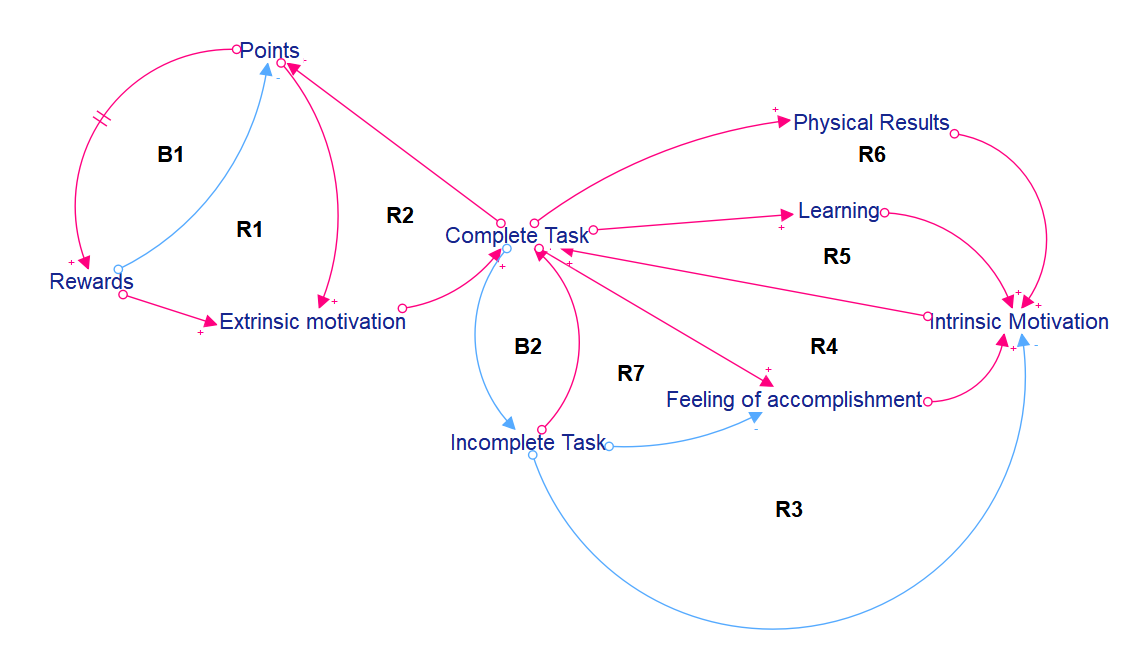
To make sure our app can give the user both intrinsic and extrinsic motivation, we took a closer look into motivation by creating a CLD.

This CLD shows how our application affects the users’ extrinsic and intrinsic motivation. As shown, there are a lot of loops affecting the intrinsic motivation.

Intrinsic motivation
When you complete a task, you get physical results, learning, and a feeling of accomplishment. All of these increase your intrinsic motivation, which results in more tasks done (R4,R5,R6). When you complete a task, the lesser incomplete tasks there are, and vice versa (B2). The less incomplete tasks, the more intrinsic motivation you get, as the work load gets smaller. This leads to more complete tasks (R6). The same happens with the feeling of accomplishment(R6).

Extrinsic Motivation
for each completed task, you get points. When you get points, you get extrinsic motivation for earning something (R2). after a while, you get enough points for a reward, which also gives extrinsic motivation (R1)
while also spending points (B1).

All in all, we can see that extrinsic and intrinsic motivation both fit in our idea. We think that parents would be driven more by intrinsic motivation, by seeing results and improvement of living conditions, while children and young adults may find the rewards and points a way to get motivated.
We’ll explore this theory in depth later.

Confidence, and Control

How can we give the users confidence and a sense of control in our app?

Using the ARCS model, we can see that the users should feel successful and that the app should create small successes along the way by completing small milestones. Our app does this through the point system, we want the user to feel accomplished whenever they complete a task. Earning points through hard work will hopefully motivate the user to do more tasks, meaning they will over time become better and do a more efficient job.

Giving the control to the users is an important factor in our app. Lepper’s control states:

  • Provide learners with a sense of control over the learning activity

This is one of the fundamentals our app is built on. The family has total control of the app, the tasks given to each individual person, the amount of points given for each task, and whether the task is accomplished or not.

Malone’s theory about challenge is also relevant here:

  • Challenges is flavored by the perception of the learner : If a user see a piece of software as a tool, he or she won’t want the use of the tool to be difficult. […]

We really want our app to be a tool, with uses of gamification to make the tool attractive. We want the app to be minimalistic and user friendly so that elderly family members and younger children could use the app simply and efficient.

In conclusion, this means that the responsibility of using the app as it’s intended falls on the users, but with the option for help ( See Scaffolding). By developing our app as a tool, making it user friendly and adaptable to each family, this app could create a foundation for confidence and control that helps the user maintain structure in their everyday lives.

Design a site like this with WordPress.com
Get started